
Buying New Development in Miami: What You Can Actually Negotiate
September 17, 2026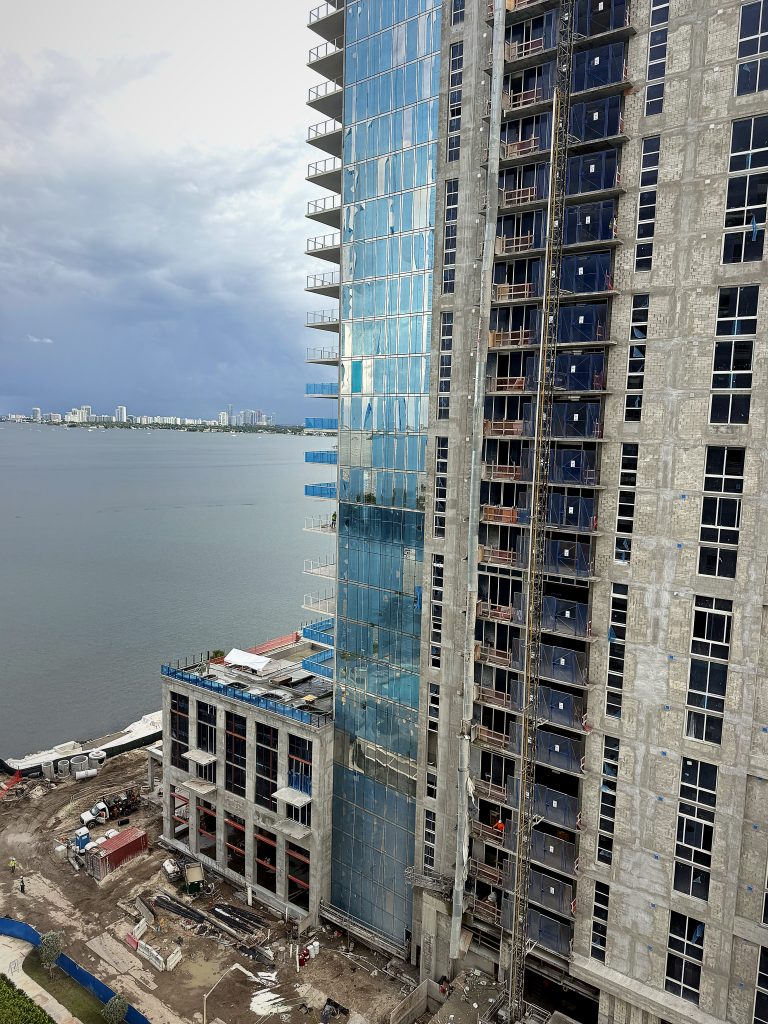
A Miami preconstruction tower mid-build on Biscayne Bay. The exposed floors and cranes are exactly what your deposit and your contract’s outside date are tied to.
Miami is in the middle of one of the most active preconstruction condo cycles in its history, and buyers moving through that pipeline tend to make the same assumption almost every time: that the purchase contract handed to them at reservation is fixed. It isn’t. Developer paperwork is written entirely in the developer’s favor, that part’s true, but nearly every clause between reservation and closing has some give if you know which ones to push on, and when. This guide walks through seven of the highest leverage negotiation points in a Miami new development contract: developer fees, the HOA allowance, time is of the essence clauses, the outside date for delivery, land assemblage and easement risk, interest on your escrowed deposit, and the buyer protections that can give you a real way out if a project goes sideways.
| This article is educational information about how Miami preconstruction contracts are typically structured, not legal or financial advice. Contract language varies by developer and project, so have a Florida real estate attorney review any purchase agreement before you sign. |
1. Developer Fees: What They Are and How Much Room You Actually Have
Nearly every Miami preconstruction contract includes a developer fee, sometimes labeled an administrative fee or marketing fee, separate from any commission paid to your buyer’s agent. Depending on the project, this typically runs somewhere between roughly 1.25% and 2.7% of the purchase price, and it’s often the first line item buyers assume is set in stone simply because it’s printed on the form contract.
It usually isn’t. Developers are generally more willing to reduce or waive this fee, or replace it with a closing credit, than to cut the headline price, because a straight price cut can undermine the appraised comps they need for the rest of the unsold inventory in the building. Your leverage is strongest around specific milestones: when a project is approaching the 50% sold mark most construction lenders require, shortly after construction financing has funded, during a softer sales period, or late in a building’s sellout when the developer is closing out the final units. Ask, and ask again at each of those windows.
2. The HOA and Association Fee Allowance
Closing on a new development unit typically requires prepaying one month of HOA fees plus two more months into the association’s reserve fund, a real, if often overlooked, closing cost. What a lot of buyers don’t realize is that developers will sometimes offer a free HOA period, waiving monthly association fees for six months to two years, as an incentive on slower moving inventory or in exchange for a faster decision or a larger deposit.
Treat this as its own negotiable line item rather than assuming it’s baked into the price you were quoted. It’s especially useful leverage for investor buyers modeling carrying costs before a unit is placed in service, since a twelve to twenty four month HOA credit can meaningfully change the first year return on a purchase.
3. Time Is of the Essence Clauses, and Why They Should Cut Both Ways

Every date in a Miami preconstruction contract, including the ones buried in the fine print, becomes a firm legal deadline once the document is signed.
A time is of the essence (TOE) clause is one of the most consequential phrases in a Florida real estate contract, and it’s easy to sign right past it without registering what it actually does. Once a contract makes time of the essence, deadlines stop being guidelines and become firm legal boundaries. Dates are counted in calendar days, not business days, performance is generally due by 5:00 p.m. local time on the deadline, and missing that window, even by a single day, can count as a material default. For a buyer, that can mean a seller declaring default and pursuing the earnest money deposit, with courts generally unwilling to grant relief once TOE language is in place.
The negotiation point most buyers miss is that boilerplate developer contracts frequently write TOE language to bind the buyer’s payment and closing obligations tightly, while giving the developer far more flexibility on its own delivery obligations through broad force majeure and outside date provisions. A buyer’s attorney can push to make time is of the essence language mutual, so it applies real consequences to both sides, or at minimum negotiate how one sided the clause is allowed to be before you sign. This is a case where the specific wording matters just as much as the concept.
4. The Outside Date for Delivery, and Why You Shouldn’t Count on Moving It
Every preconstruction contract states an estimated completion date, but buried further in is a second, much later date, the outside date, by which the developer must legally deliver the unit or the buyer gains the right to terminate and recover their deposit. That outside date is routinely a year or two beyond the estimated completion date, and force majeure carve outs for labor disputes, material shortages, weather, and government delay can push the effective deadline out even further.
Despite what you’ll sometimes hear, the outside date itself is one of the hardest terms to move for an individual buyer. It’s the developer’s core protection against delay driven rescission claims, and shortening it for one buyer while leaving it untouched for everyone else creates exactly the kind of uneven contract most developers won’t sign off on. Leverage here is real but narrow. It shows up late in a sellout when a developer is chasing final units, on large or bulk purchases, or on projects that are already vertical and financed, where a shorter outside date reflects real certainty rather than a concession. Early in a sellout, before a project has broken ground or hit its presale threshold, expect this date to hold.
What’s more realistically achievable is protection layered on top of the outside date rather than a shorter one. Think a milestone based cancellation right written as a separate provision, for example the right to cancel if vertical construction hasn’t reached a specific floor by a specific date, or a per month credit if the developer misses the estimated date but stays within the outside date. Both give you real protection without asking the developer to rewrite the uniform terms every other buyer in the building signed. Read the force majeure section closely either way, since it’s often where an outside date that looks reasonable on its face quietly becomes much longer in practice.
5. Land Assemblage and Easement Risk, or What You’re Actually Buying Into
Many Miami towers, especially in tightly built corridors like Edgewater and Brickell, aren’t built on a single parcel the developer already owns outright. They’re assembled from two, three, or more adjoining lots purchased from different sellers, sometimes over months or years. It’s common for a developer to begin marketing units and signing buyer contracts before every one of those underlying parcels has actually closed, because strong presale numbers are often what unlocks the construction financing needed to complete the assemblage in the first place. That sequencing means your purchase contract can be signed before the developer has full legal control of the land the building is supposed to sit on.
In practice, an assemblage falling apart entirely is rare. The far more common outcome is delay, not failure. A parcel that hasn’t closed yet is usually a matter of financing timing or a seller working through their own contingencies, and the closing dates on those underlying land contracts are often set well out precisely to give the developer room to get there. But usually fine isn’t the same as guaranteed. If one piece of the assemblage doesn’t close, whether that’s a title defect, a seller default, unresolved litigation, or a financing failure, the project as marketed may need to be redesigned, delayed materially, or in the worst case, may not proceed at all. Ask your agent or attorney to confirm through the public property records whether the developer has actually closed on every parcel in the footprint, or whether any piece is still under contract, and make sure your purchase agreement gives you a real, dated way out. You want an automatic right to cancel and recover your deposit, with any interest earned, if the developer hasn’t achieved full site control by a specified date.
Even once a site is fully assembled, existing easements on the property can quietly shape what actually gets built and how the building operates once it’s open. It’s not unusual in Miami for a development parcel to share an ingress and egress, utility, or parking easement with a neighboring property, a church, a smaller commercial building, or another owner who was there long before the tower was ever proposed, and for that easement to survive the assemblage and keep binding the new building. Depending on its terms, a shared easement can affect construction staging and access during the build, the final footprint of a motor court or loading area, or an adjacent party’s ongoing right to use part of what looks, on the marketing materials, like exclusively the building’s own property. Ask specifically about any recorded easements affecting the site (a title commitment and survey will show them) and have your attorney confirm how they’re addressed in the final site plan before you assume the renderings reflect exactly what will be built.
6. Interest on Your Escrowed Deposit, Money Most Buyers Leave on the Table
Florida law requires the developer to hold the first 10% of your purchase price in escrow until closing, or until a permitted release event, and it explicitly allows, but does not require, that escrow account to be interest bearing. The catch is in the default rule. If your purchase contract is silent on the subject, any interest earned while your deposit sits in escrow is paid to the developer at closing, not to you. On a multi million dollar Edgewater or Brickell unit with a 20%, 30%, or higher deposit sitting in escrow for two, three, or more years between contract and closing, that’s real money quietly defaulting to the developer’s side of the ledger simply because the contract never said otherwise.
There’s one bright spot buyers often overlook. For funds held during the reservation period, before you’ve signed a binding purchase contract, Florida law already defaults in your favor. Interest on a reservation deposit is payable to the prospective purchaser unless the reservation agreement specifically says otherwise, so read that document as closely as you’d read the purchase contract itself, especially if your reservation sits for many months before it converts.
Once you’re past reservation and into the signed contract’s 10% escrow deposit, the ask is straightforward. Request that the escrow account be interest bearing and that the contract redirect interest earned to the buyer, or credit it against the purchase price, at closing, rather than defaulting to the developer. This costs the developer nothing but bookkeeping. It doesn’t touch their construction financing, their delivery obligations, or any other buyer’s contract, which makes it one of the lower friction asks on this list even though many buyers and agents never think to raise it. Some developers will still say no, since interest aggregated across hundreds of buyers over a multi year construction cycle adds up to real income on their end, but it’s a legitimate, statute sanctioned request worth putting in writing every time.
7. Building In Your Own Way Out
Florida law gives buyers a fifteen calendar day rescission period after receiving the condominium documents, during which a purchase can be cancelled penalty free. But that clock should start only once you’ve actually received the complete document package, so confirm delivery in writing rather than assuming the countdown began earlier. Beyond that statutory window, a carefully negotiated contract can add several exit triggers that favor the buyer and don’t exist in the standard form: the right to cancel and recover your full deposit if the developer misses the outside date, protection against material substitutions if promised finishes get swapped for lower grade alternatives, and, where a contract otherwise restricts it, negotiated assignment or resale rights that let you sell the contract itself before closing rather than being locked in until completion.
It’s also worth understanding what happens to your money along the way. Unlike some states that require full deposit escrow, Florida developers are permitted to use up to 10% of buyer deposits for construction costs before closing, which is one more reason a clearly negotiated set of cancellation and refund triggers matters more here than in markets with stricter deposit protection. The strongest position is to negotiate these protections into the contract at signing, rather than assuming standard buyer protections apply, because in a contract drafted by the developer, they usually don’t unless you put them there.
Red Flags Worth Reading Twice
A handful of contract patterns are worth extra scrutiny before you sign, even when everything else about a project looks solid. Watch for force majeure language broad enough to cover ordinary business delays rather than genuine emergencies, since an overly generous definition can quietly swallow the protection your milestone based cancellation rights were supposed to provide. Watch for a developer’s right to make unilateral design or material changes with no buyer notice requirement, which undercuts any material substitution protection you negotiate elsewhere in the contract. Watch for silence on site control. A contract that never confirms the developer has closed on every parcel in the assemblage hasn’t addressed what happens to your deposit if it doesn’t. And watch closely for how deposits are treated if the project is abandoned or the developer’s construction financing falls through. Florida’s rules allowing developers to spend a portion of buyer deposits during construction make it worth understanding exactly what happens to your money in a worst case scenario, not just in the smooth closing scenario the sales gallery walks you through.
Negotiate Before You Sign, Not After
Almost all of the leverage in a Miami preconstruction purchase exists in the window before you sign. Once a contract is executed, you’re working within whatever terms made it into that document. That’s why serious buyers pair an experienced preconstruction agent, someone who knows which developers routinely grant fee waivers, HOA credits, or milestone based cancellation rights and which don’t, with a Florida real estate attorney who reads these contracts for a living. Chueire Estates negotiates these terms on behalf of buyers across Edgewater, Brickell, and the rest of Miami’s active preconstruction pipeline, and we’re glad to walk through a specific contract with you before you commit. For building specific guidance, see our companion rankings of Edgewater’s best buildings and South Brickell’s best buildings.
Whether you’re just starting to shop preconstruction inventory or you’re already under contract and want a second set of eyes on the developer fees, HOA allowance, or outside date you’ve been offered, contact Wilson directly at wilson@chueiregroup.com. And if you already own in a building that’s nearing delivery and want to know what your contract or unit is worth in today’s market, reach out to the same address for a complimentary, no obligation price analysis.